
January 27, 2026 | By admin
At 2:17 a.m., Raghav stared at the ceiling, counting hairline cracks like constellations. Sleep refused to come, despite the plush new mattress they had bought just a fortnight ago. Beside him, Nisha slept deeply—one leg draped across his thigh, the duvet tucked tightly around her shoulders, her breathing slow and rhythmic. A soft but determined snore confirmed her comfort. Somewhere between counting cracks and shifting pillows, Raghav realized this was not a marriage problem. This was a mattress problem.
By morning, the imbalance was unmistakable. Nisha woke refreshed, scrolled through her phone, and planned her day with calm efficiency. Raghav dragged himself out of bed with burning eyes and a throbbing head. He snapped at traffic—and later at Nisha—in the way only an ill-rested person does when patience runs out too quickly. At breakfast, Nisha was cheerful as ever. Raghav was silent, not because of unresolved emotional issues, but because he had barely slept.
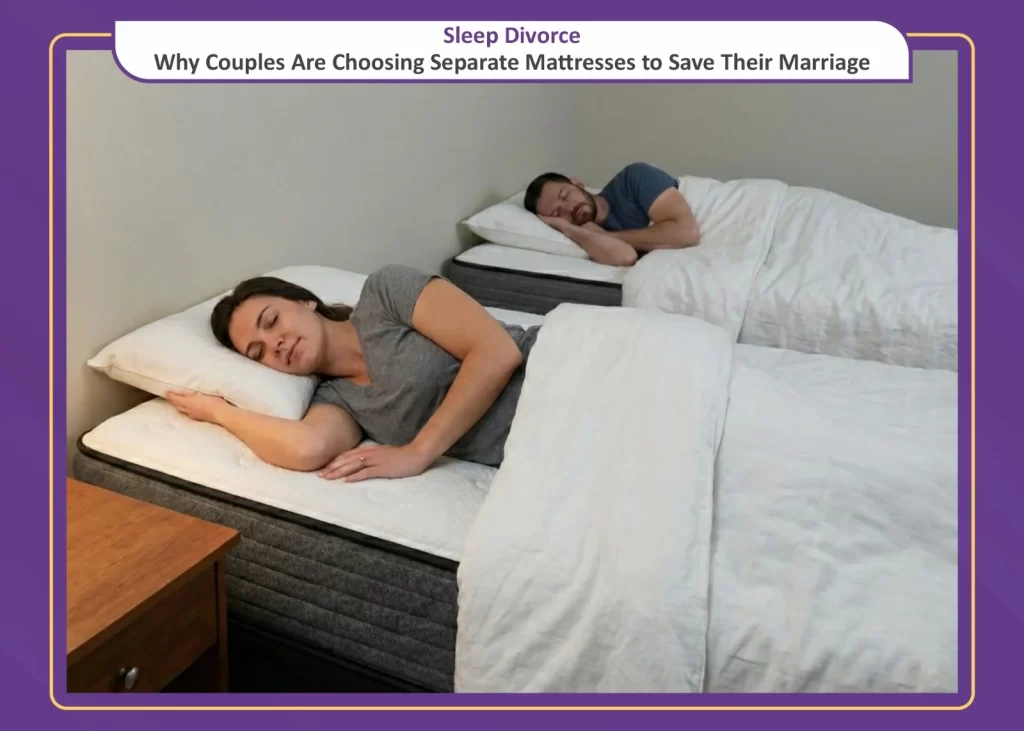
This scenario is increasingly common and sits at the heart of a growing trend known as “sleep divorce”—a conscious decision by couples to sleep on separate mattresses, or even in separate beds, to protect their sleep, mental health, and relationship.
Despite its dramatic name, sleep divorce is not about emotional distance. It is about biological reality.
Sleep is not optional maintenance; it is a foundational human function. Quality sleep directly affects mood regulation, cognitive performance, emotional resilience, productivity, immunity, and long-term health. When sleep is compromised night after night, even the most compatible partners begin to feel misaligned. And when only one partner is consistently sleep-deprived, resentment often builds quietly and invisibly.
In Raghav and Nisha’s case, the incompatibility had existed for years. Raghav preferred a firm mattress, slept flat on his back, and needed near-Arctic room temperatures. Nisha loved a plush surface, slept on her side, wrapped herself tightly in blankets, and believed air-conditioning was optional. Add mismatched schedules—his late-night reading and her early-morning workouts—and their shared bed had become a one-sided arrangement. Nisha slept soundly. Raghav spent his nights adjusting pillows, reclaiming pieces of blanket, and watching the clock inch toward morning.
What made matters worse was the unspoken belief that “good couples sleep together.” Society has long romanticized shared sleep as proof of intimacy. Separate beds are still wrongly associated with emotional distance or failing marriages. In reality, chronic sleep deprivation—especially when borne by one partner—is far more damaging to intimacy than sleeping apart.
Research consistently shows that lack of sleep reduces empathy, patience, and impulse control. A tired brain interprets neutral comments as criticism, minor inconveniences as personal attacks, and small disagreements as major conflicts. Over time, this strain spills into work and social life. Poor sleepers are less focused, more reactive, and often perceived as irritable or disengaged.
Nisha noticed the contrast first. After uninterrupted sleep, she moved through her day with clarity and confidence. Raghav, once calm and solution-oriented, became defensive, withdrawn, and mentally foggy. Their personalities had not changed—their sleep quality had, unevenly.
This is why sleep divorce is gaining acceptance. Modern life already strains the nervous system. Long work hours, screen exposure, irregular routines, and constant stimulation make restorative sleep harder to achieve. Expecting two adults with different physiological needs to sleep optimally on one mattress often means one thrives while the other pays the price.
Choosing separate mattresses is not a rejection of partnership; it is an acknowledgment of individuality. Healthy relationships require two regulated individuals, not one rested partner and one perpetually exhausted one clinging to outdated ideals.
When couples protect both partners’ sleep, they are not creating distance. They are restoring balance—to their days, their work, and their relationship.
Leave a Reply